TL;DR: Most ADHD tests measure symptoms, not your experience of them. A score won’t validate you. Understanding what a test actually does, what it misses, and why it keeps failing women and late-diagnosed adults is more useful than any quiz result.

You’ve already taken one. Possibly three.
You scored high, felt something shift in your chest, then closed the browser and told yourself it was probably meaningless. It was free. It was online. Anyone could pass it. It probably wasn’t designed for someone like you.
Here’s what nobody says out loud: you’re not wrong to be sceptical, but you’re sceptical about the wrong thing.
The issue isn’t that the tests are too easy to pass. The issue is that most people searching for an ADHD test aren’t actually looking for a score. They’re looking for someone credible to tell them that what they’ve been experiencing is real. And a quiz, no matter how well-designed, cannot do that job.
The Common Belief Worth Examining
The standard advice goes like this: take a validated screening tool, score above the threshold, take that to your GP, get referred.
It sounds straightforward. People repeat it constantly on forums, in YouTube videos, in the NHS guidance that ranks third on Google.
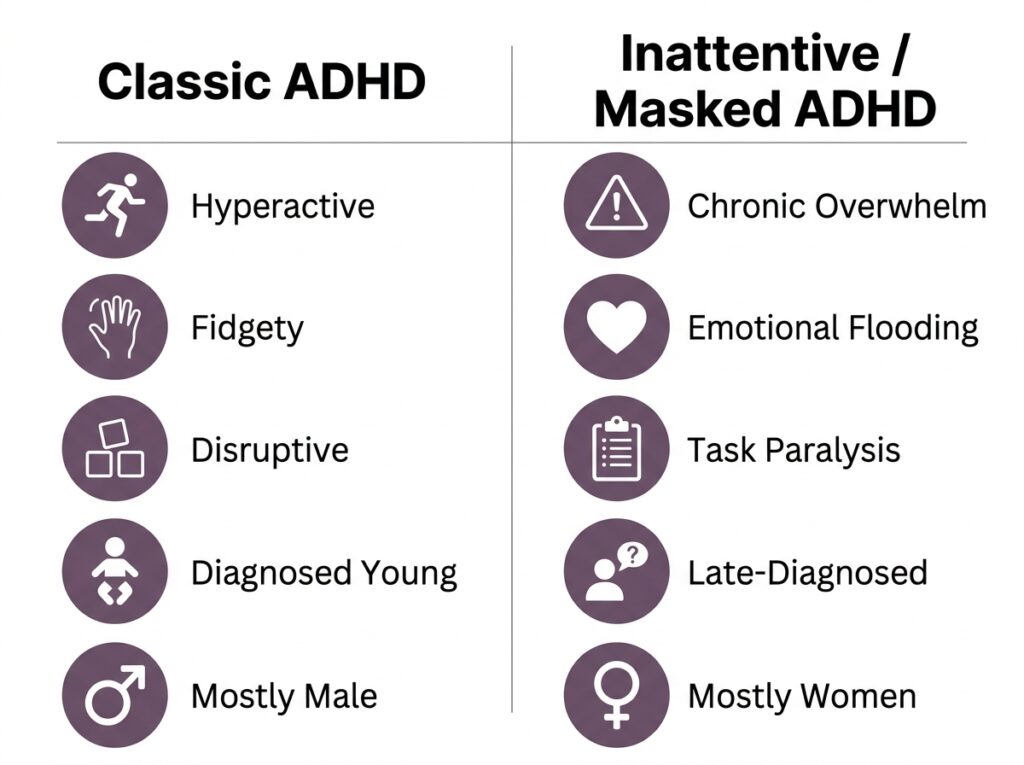
The problem is that advice was built for a version of ADHD that was studied almost entirely in hyperactive young boys.
The screening tools in most common use, including the Adult ADHD Self-Report Scale (ASRS) and variants of it, were validated on populations that skew male, skew hyperactive, and skew childhood-onset obvious. If your ADHD looks like chronic overwhelm, emotional flooding, paralysis in the face of a simple task, or a brain that simply refuses to start things it isn’t interested in, those tools were not built to catch you.
This isn’t a fringe opinion. Research consistently shows that women are diagnosed later, dismissed more often, and more likely to present with inattentive symptoms that don’t fit the classic profile. The tests didn’t fail you by accident. They were built without you in mind.
What an ADHD Test Actually Measures
Let’s be precise about what these tools do, because most content on this topic skips it entirely.
A screening questionnaire measures frequency of symptoms, not the functional impact of them. It asks how often you lose things, how often you get distracted, how often you struggle to finish tasks. It does not ask whether those things have cost you a career, a relationship, your sense of self-worth, or ten years of believing you were fundamentally flawed.
The clinical diagnostic process, when done properly, is different. It looks at:
| What screening does | What proper assessment does |
| Measures symptom frequency | Measures functional impairment across life domains |
| Compares you to a norm | Explores your personal history from childhood |
| Produces a score | Produces a clinical picture |
| Takes 5 to 15 minutes | Takes several hours over multiple sessions |
| Can be done alone online | Requires a qualified clinician |
| Cannot diagnose | Can diagnose |
A screening test is a prompt to seek proper assessment. It is not an assessment. The moment you understand that distinction, the whole landscape changes.
Why the GP Route Fails More People Than It Should
Most people take their quiz scores to their GP and leave feeling worse than when they arrived.
They get told they seem fine. They get told everyone struggles with focus sometimes. They get told their anxiety or depression needs to be treated first. They get put on a waiting list for an NHS assessment that, depending on where they live, could be two to five years long.
None of that means they don’t have ADHD. It means the system was not built for the volume of adults now recognising themselves in the diagnosis.
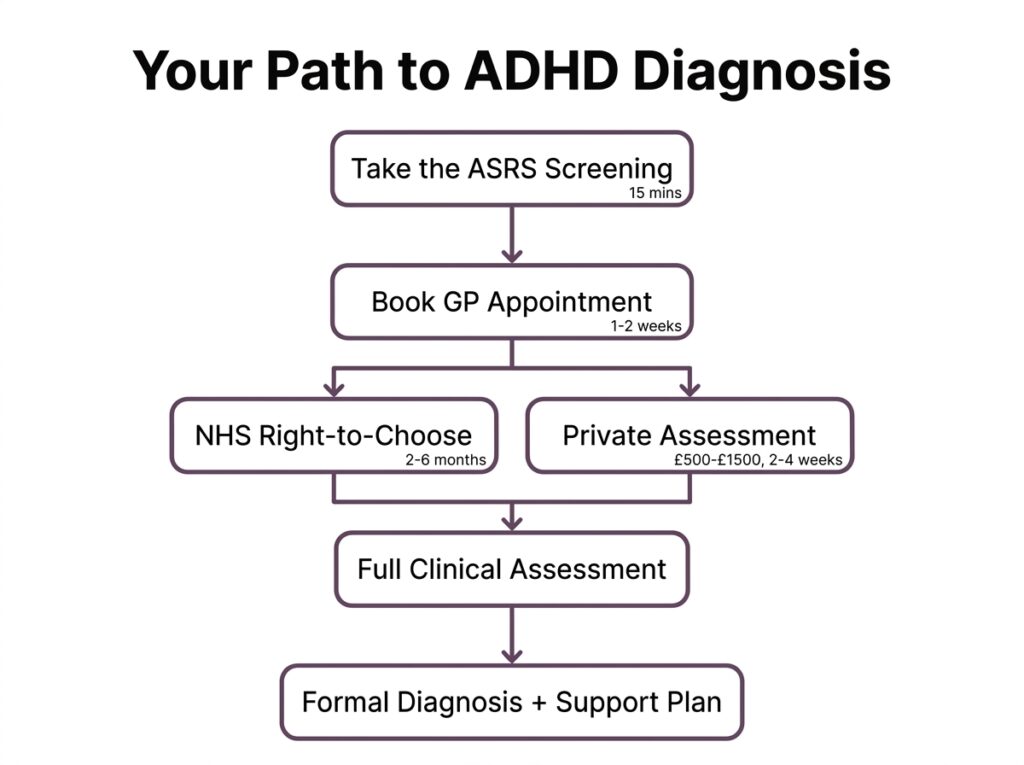
The NHS right-to-choose pathway exists and is underused. It allows you to request assessment from an independent provider commissioned by the NHS, which can cut waiting times significantly. It is not widely advertised. Most GPs will not mention it. how to get an ADHD diagnosis as an adult in the UK
Private assessment is available through a number of clinics, typically running from £500 to £1,500 for a full assessment. The price is real and it is not accessible to everyone. But it is also not the only option, and knowing both pathways exist is more useful than sitting on a waiting list you were never properly told about.

The Belief That’s Actually Keeping You Stuck
Here is the real pattern underneath all of this.
You took the quiz. You scored high. You felt seen, briefly, then found a reason to dismiss it. Maybe you thought: I can focus when I really care about something, so maybe I don’t have it. Maybe you thought: Everyone’s a bit like this, I’m just weak. Maybe you thought: A GP looked at me and said nothing, so I probably imagined it.
Those are not rational conclusions. They are a defence mechanism built from years of being told the problem was you.
The hallmark of ADHD in adults who’ve been undiagnosed for decades is not chaos. It is high-functioning exhaustion. It is people who’ve built elaborate systems to compensate, who have pushed harder than everyone else just to produce the same results, who’ve been so skilled at masking that even the people closest to them have no idea how hard every ordinary thing has been.
A quiz score won’t override years of internalised messaging that you’re just not trying hard enough. Nothing will, until you’re sitting in front of someone who specialises in this, who has seen a thousand versions of you, and who can say: yes, this is real, and here is what it is.
That appointment is what you’re actually searching for. The quiz is just the door.
What to Do Right Now That Actually Moves Things Forward
Stop waiting to feel more certain before you seek assessment. The certainty doesn’t come before the assessment. It comes because of it.
Here is a practical sequence:
- Do the ASRS (the Adult ADHD Self-Report Scale, the most widely used validated screening tool in the UK). It’s not perfect, but it gives a clinician a baseline. [what happens at an ADHD assessment]
- Book a GP appointment and use specific language. Don’t say “I think I might have ADHD.” Say “I’ve completed the ASRS screening tool and scored above the threshold. I’d like a referral for formal assessment, and I’d like to discuss the right-to-choose pathway.”
- Request the right-to-choose referral explicitly. You are entitled to this under NHS England policy. You may need to ask twice.
- If you go private, vet the provider. Look for clinicians who are GMC or HCPC registered. Check that your assessment includes a clinical interview, not just a questionnaire.
- Document your history. Before any assessment, write down specific examples from your life: tasks that take you disproportionately long, things you’ve avoided chronically, ways you’ve compensated. Clinicians need this. Don’t assume they’ll ask the right questions.
The goal is not to get a label. The goal is to get an explanation that finally fits, and from that, access to support that actually works.
Frequently Asked Questions
Can an online ADHD test actually diagnose me?
No. Online tests are screening tools only. They can indicate whether your symptoms align with ADHD and give you a starting point for a clinical conversation, but only a qualified clinician can make a formal diagnosis.
I scored really high on an ADHD quiz but my GP dismissed me. What should I do?
Ask specifically about the NHS right-to-choose pathway, which entitles you to request assessment from an independent provider rather than waiting for a local NHS referral. If your GP is unhelpful, you can ask to see a different GP or contact the practice manager.
Why do I feel like I can focus sometimes? Does that mean I don’t have ADHD?
Hyperfocus, the ability to lock in intensely on things that interest you, is actually a recognised feature of ADHD, not evidence against it. ADHD is not an inability to focus on anything. It is difficulty regulating where and when focus happens.
Are ADHD tests different for women?
Most widely used screening tools were not validated on female populations and tend to undercount inattentive presentations, which are more common in women. A good clinician will be aware of this. If you feel unseen by a questionnaire, say so during your assessment.
How long does a proper ADHD assessment take in the UK?
A thorough assessment typically involves at least two to three hours of clinical interview, background questionnaires, and sometimes input from a person who knew you as a child. Be cautious of any service offering a full diagnosis from a single short session.
Your next move: Take the ASRS screening tool, note your score, and book a GP appointment this week. Go in prepared with specific examples from your life and ask directly about the right-to-choose pathway. You don’t need to be more certain before you do this. You just need to start.